



Benford’s law


This blog was written by Nic Martin, our Co-Founder and CTO. Nic studied Physics at University and has an ingrained interest in statistics.
Recently a colleague told me about Benford’s Law. The law states that in many naturally occurring collections of numbers, the leading digit is likely to be small.

{Benford’s Law maintains that the numeral 1 will be the leading digit in a genuine data set of numbers 30.1% of the time; the numeral 2 will be the leading digit 17.6% of the time; and each subsequent numeral, 3 through 9, will be the leading digit with decreasing frequency}
We thought it would be interesting to see if Market Dojo data followed this law. Specifically, we chose to look at the leading digit of bids placed on our platform.
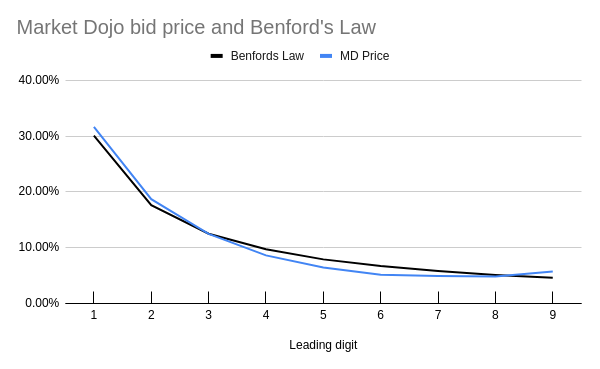
It is easy to see there is a correlation. So, we can add Market Dojo bids to the list of data sets that Benford’s law along with electricity bills, street addresses, stock prices, house prices, population numbers, death rates and lengths of rivers!
Bids in our system are for a single unit, we call them ‘bid prices’. They are against a quantity of items the quantity varies greatly between different lots. We refer to price x quantity as ‘bid value’. How does this look?
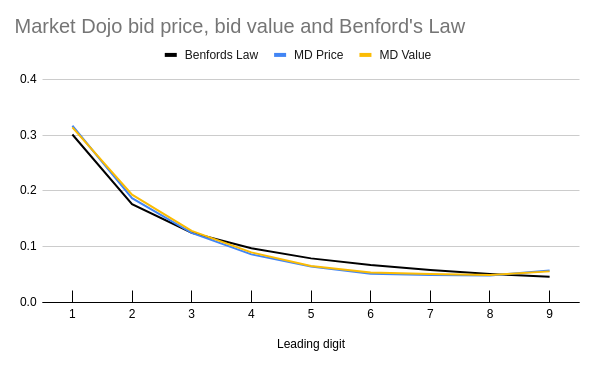
Again, there is a really close correlation between the two.
How about quantity alone?
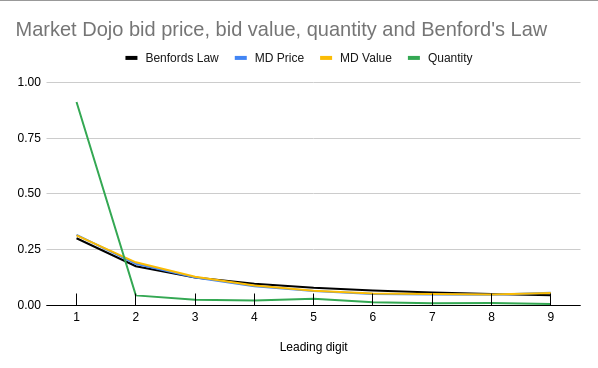
Hmm, things start to fall down here. You can see that 1 appears more frequently than other digits. This reflects the fact that our customers often ask for bids on a quantity of 1. There are a few reasons this might be:
- that is how they prefer to view the bids,
- they don’t have an accurate forecast of the quantity they will require
- they actually just want 1 of the thing they are buying
How about if we exclude quantities of 1?
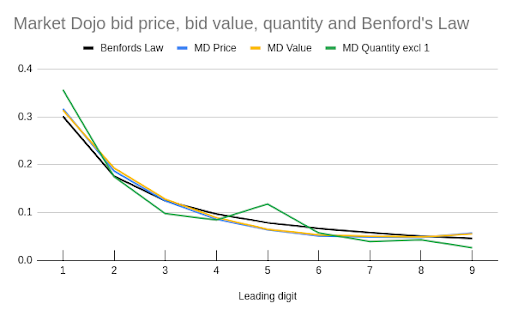
Now, we are very close to the rule again. There is a bit of a spike around 5. Being a frugal bunch, perhaps our customers don’t want to commit to buying more than they can count on the fingers of one hand.
How can we use this?
Benford’s Law is used for accounting fraud detection; has been proposed for use in identifying election fraud; and has even been used to look for errors in national COVID-19 statistics.
I was interested to see whether we could use Benford’s Law to detect some known, non-genuine bidding patterns on our platform. To achieve this I took some events which each had more than 1,000 bids, 6 genuine and 4 test events, created by our performance team.
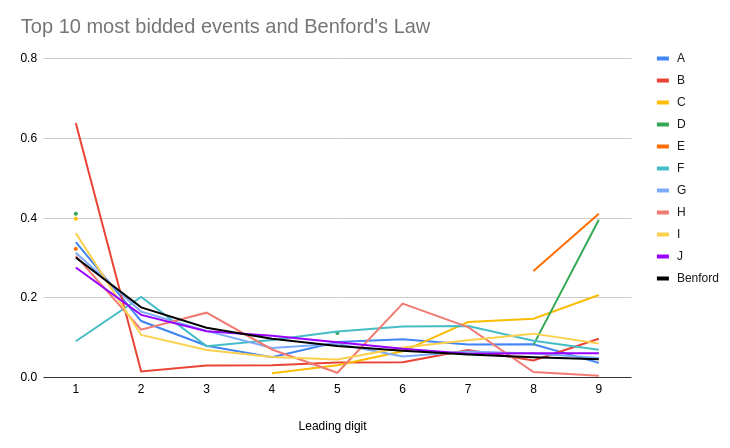
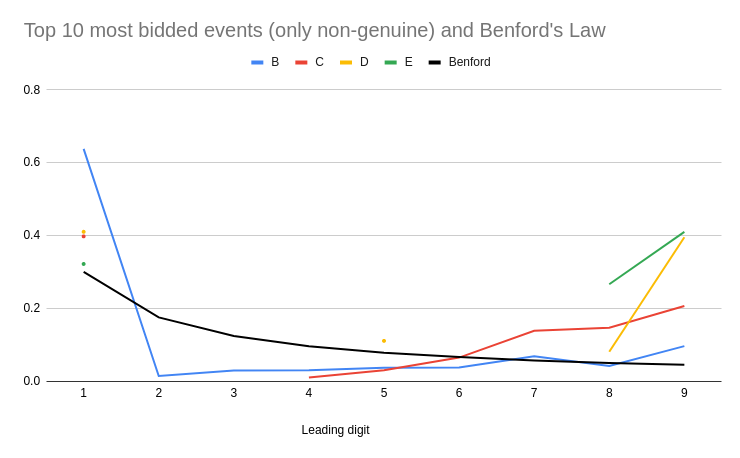
We can see that events B, C, D & E are all obvious outliers, with B far above the expected frequency for 1; E, D above the frequency for 9; and C having a U shape.
When I checked the events I confirmed that these four events were all run by Market Dojo employees and had names indicating they were test events. The remainder of the events were genuine and seemed to be a closer match.
Conclusion
We can add Bids on Market Dojo to the list of data-sets which Benford’s Law applies to. We can use the Law to identify events on our platform which were generated by our testing team.
While this works well for events with a large number of bids, it is not likely to be effective for events with fewer bids. Therefore, I am not confident that we will be able to deploy this technique, for example to automate our work to prevent schill bidding.
 September 30, 2020