


The Procurement Leader’s Strategic Sourcing Activation Plan: A Roadmap for Modern Value Creation


We recently shared our vision for modern strategic sourcing in a SIG webinar titled The Procurement Leader’s Strategic Sourcing Activation Plan: A Roadmap for Modern Value Creation.
This article distils the key insights from the discussion, outlining the challenges of traditional sourcing and detailing a five-step activation plan designed to future-proof procurement strategy, maximise supplier engagement, and deliver measurable ROI.
Moving past the old world of sourcing
Strategic sourcing has changed significantly over the last 25 years. Traditionally, sourcing followed a very linear approach, exemplified by Kearney’s seven steps, requiring teams to proceed through every single step to hit their strategy.
In the ‘old world,’ sourcing was very category-focused, making it difficult to accommodate ad hoc cases. The supplier view was highly transactional, lacking ongoing visibility of performance. Once contracts were signed, they were often simply filed away, making the tracking of ongoing results a major failure point. Furthermore, everything was often siloed, making a holistic view difficult.
Today, the new world demands a connected approach. While the foundational steps remain similar, modern strategic sourcing focuses on orchestration, scalability, and integration. Key shifts include
- Whole business engagement: Ensuring the entire enterprise is linked with procurement to see the impact being made
- Strong supplier relationships: Developing these partnerships has become a major talking point in recent years
- Data intelligence: Learning from past engagements to drive future progress
- Seamless integration: Ensuring easy-to-digest reporting and seamless integration between various functions
Market Dojo’s experience aligns with market research, highlighting the prevalent need for digitisation: a Deloitte survey found that 50% of organisations still use manual methods like email and spreadsheets. Crucially, 74% of organisations are already on the journey to digital transformation.
The 5-step strategic sourcing activation plan
The webinar outlined a clear roadmap to help procurement teams build maturity and performance, enabling them to move from basic digitisation to advanced automation.
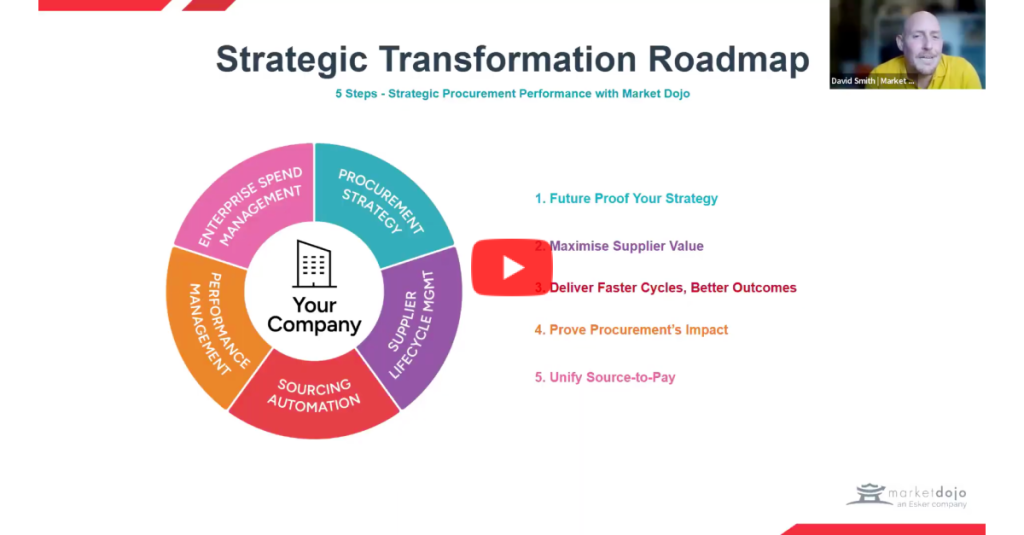
Step 1: Future-Proof Your Strategy
The initial step is about harnessing the correct tools to uncover savings, prioritise initiatives, and align procurement activity with wider business goals.
Common challenges include limited visibility on company-wide spend, weak alignment with corporate strategy, and the necessity of making reactive sourcing decisions without clear prioritisation.
To combat this, tools focused on spend analysis are key, helping teams consolidate data across categories, regions, and business units to segment spend (strategic, tactical, non-critical) and highlight cost savings and compliance gaps. Furthermore, category management tools assist in analysing cost drivers and demand patterns, allowing teams to develop tailored strategies aligned with business priorities and risk appetite.
This process results in faster, evidence-based decision-making and positions procurement as a strategic partner, rather than a tactical blocker. However, it is important to note that teams do not need to ‘shoot the moon’ immediately; even accessing data on key spend areas can set the organisation on the right path.
Step 2: Maximise Supplier Value
Once the strategy is in place, the focus shifts to ensuring maximum value is derived from the supply base. Historically, tracking how a supplier performs or leveraging their potential for further insight has been difficult.
Key challenges include slow, manual supplier onboarding and internal approvals, difficulty vetting suppliers to meet compliance demands, and a lack of visibility into ongoing supplier performance.
To address this, modern procurement requires a suite of tools
- Supplier onboarding to efficiently log information and ensure compliance
- Third-party risk management to access independent risk data and gain oversight of the supply chain
- Supplier performance management to quantify and score how suppliers are doing against metrics, offering an overall picture of relationships
- Supplier innovation tools to foster continuous communication, allowing businesses to gather ideas from their supply chain on how to achieve specific goals, rather than sourcing in a vacuum
Improved collaboration leads to improved functions later down the line, enabling a strong innovation pipeline and reduced risk.
Step 3: Activate Sourcing and Automation
The activation phase focuses on delivering faster cycles and better outcomes by scaling competitive events supported by powerful insights.
Common pain points include high admin burden on procurement teams, reliance on manual tendering, and limited competition in supplier selection.
Modern tools integrate advanced features to overcome these hurdles, see table below.
| SOLUTIONS / TOOLS | DESCRIPTION & IMPACT |
| Supplier discovery (via Veridion) | Allows users to search and qualify new suppliers across global markets, comparing them based on cost, quality, compliance, and rising ESG metrics. This helps build a resilient supplier base. |
| RFQs and multi-stage tenders | Standardised templates and an AI assistant—trained by in-house professionals—can create questionnaires based on simple text prompts, helping teams balance price against quality and risk factors. |
| Auctions | Enables the creation of competitive tension in real-time using various formats (reverse, Dutch, ranked) to secure better pricing and centralise data. |
| AI automation | AI is used deliberately to solve real headaches, primarily by saving time. Tools include an AI assistant for adoption support and a new feature that allows users to create full sourcing events from scratch using only a few prompts. Future developments include recommendations for lot structures, scoring models, and predicting savings/risk outcomes. |
| Contract management | Centralises contracts, automates alerts for renewals/expirations, and tracks performance against agreed terms and KPIs. |
This approach dramatically improves efficiency. In one case study, a global environmental management corporation saw a 50% reduction in time spent and a 24x ROI on licensing after automating their sourcing events.
Step 4: Demonstrate ROI and Optimise Resources
It is critical that procurement teams not only perform well but also prove their impact to the wider business. Without proper data, it can be hard for procurement to get a ‘seat at the table’.
Challenges often revolve around inconsistent tracking of savings (both leading and lagging indicators) and poor visibility of upcoming sourcing projects and the resources required.
To solve this, savings tracking allows monitoring of performance versus expectation. Pipeline management handles individual requests and converts them into structured sourcing activity. The outcome is a more transparent representation of ROI, improved budgeting credibility, and the ability for procurement to show wider value beyond just saving percentages, such as efficiency gains.
Step 5: Achieve Organisational Wide Transparency and Intelligence
The final step is focused on bringing procurement and finance together to provide organisational-wide 360-degree understanding of data, ensuring it is actionable.
Common problems include disconnected systems, maverick spending outside of contracted suppliers, manual input leading to errors, and weak alignment between procurement, finance, and strategic goals.
Leveraging integrated solutions and partners allows for full Source-to-Pay (S2P) visibility. This is achieved through tools like
- Purchasing (standardising requests and enforcing compliance).
- Accounts Payable (automating invoice matching and reducing payment errors).
- Payment Integration (end-to-end traceability and reconciliation).
- Intake and Orchestration (a centralised intake portal for procurement requests, ensuring company-wide adoption and standardisation).
Ultimately, these combined steps create a single source of truth, enabling informed decisions at an organisational-wide level.
To support procurement leaders on this journey, Market Dojo has created a Sourcing Hub with resources and playbooks that align with each pillar of this roadmap, helping teams test, learn, and drive digital transformation. Visit the Sourcing Hub today!
 October 30, 2025